
Hot Wallet vs Cold Wallet
A hot wallet and a cold wallet both store the keys that let you access Bitcoin, but they do not offer the same level of exposure to online risk. Understanding the difference is one of the clearest ways for beginners to make smarter storage decisions.
The primary keyword should appear naturally in the H1 and opening paragraph, which this does.
01-
What Is the Difference Between a Hot Wallet and a Cold Wallet?
Key Takeaway
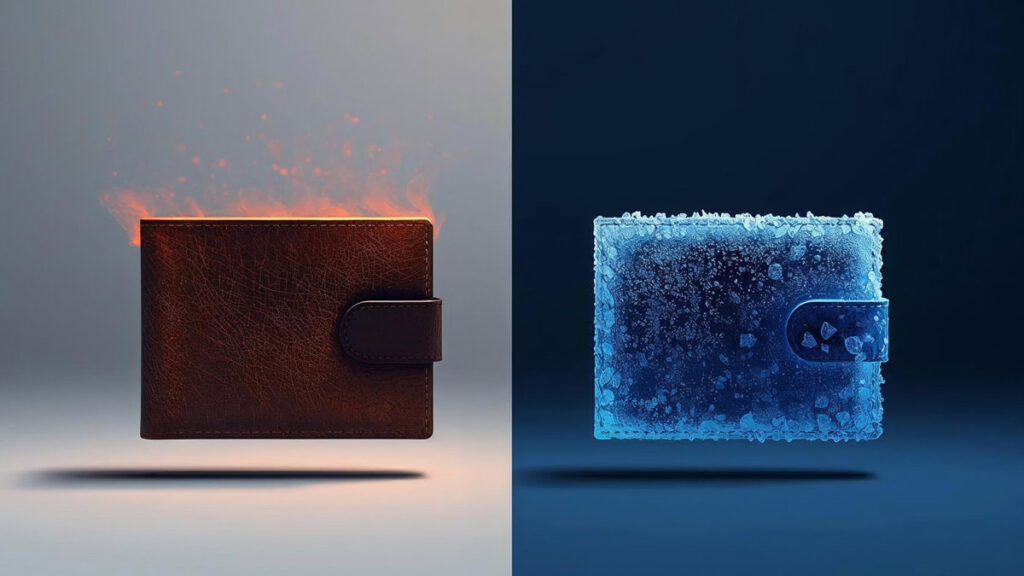
A hot wallet is connected to the internet in some way. A cold wallet is designed to keep the signing environment offline or more isolated from online exposure.
A hot wallet and a cold wallet both serve the same basic purpose: they help you manage the keys that let you access and use Bitcoin. The real difference is not whether one is “a real wallet” and the other is not. The difference is how exposed the wallet is to online risk.
A hot wallet is typically connected to the internet through a phone, computer, browser extension, or another online device. That makes it easier to use for day-to-day access, learning, or smaller amounts. It also means the wallet environment is generally more exposed to phishing, malware, and other internet-based threats.
A cold wallet is designed to reduce that exposure by keeping the signing process offline or more isolated. This usually makes it better suited to long-term storage or larger amounts, where stronger protection matters more than convenience. It does not remove all risk, but it changes the type of risk you are dealing with.
For beginners, the simplest way to think about it is this: hot wallets usually optimize for ease of use, while cold wallets usually optimize for stronger security separation. That is why the comparison matters so much in self-custody decisions.
The core distinction
- Hot wallets are connected to the internet in some way
- Cold wallets are designed for stronger separation from online risk
- Hot wallets are often easier to use
- Cold wallets are often better for long-term protection
- The right choice depends on amount, experience, and purpose
02 –
What Is a Hot Wallet?
A hot wallet is a Bitcoin wallet that is connected to the internet in some way. This can include a mobile wallet app, a desktop wallet, a browser extension wallet, or another setup that relies on an online device for regular use.
The main advantage of a hot wallet is convenience. It is usually faster to set up, easier to access, and simpler for beginners to use when learning how wallets work. For small amounts or more active use, that convenience can make a hot wallet a practical starting point.
The trade-off is that convenience usually comes with more online exposure. Because the wallet environment is connected to the internet, there is generally more risk from phishing, malware, fake websites, or compromised devices. That does not mean every hot wallet is unsafe, but it does mean the surrounding security habits matter more.
For beginners, a hot wallet often makes sense for learning, testing small amounts, or becoming familiar with self-custody before moving to a setup with stronger long-term protection.
When a hot wallet may make sense
- You are learning how self-custody works
- You are storing only a small amount
- You want quick and easy access
- You understand the extra online risk
- You are not relying on it for long-term high-value storage
03 –
What Is a Cold Wallet?
A cold wallet is a Bitcoin wallet designed to keep the signing environment offline or more isolated from internet-connected devices. In practice, this usually means it is built for stronger protection against online threats than a typical hot wallet.
The main advantage of a cold wallet is security separation. Because it reduces direct exposure to the internet, it can lower certain risks such as malware, phishing, or compromised devices. That is why cold wallets are often preferred for larger amounts or longer-term storage.
The trade-off is that a cold wallet is usually less convenient than a hot wallet. Setup can feel more serious, recovery planning matters more, and sending Bitcoin may take a few extra steps. For beginners, that added friction is not necessarily a bad thing, but it does mean the setup should be understood properly.
A cold wallet often makes the most sense when the amount held has become important enough that stronger protection is worth the extra responsibility. It is not automatically the right choice for every situation, but it is often the stronger option for long-term self-custody.
Core idea
A cold wallet is usually chosen for stronger long-term protection, not for maximum convenience..
04-
Which One Is Safer?
In general, a cold wallet is considered safer for long-term storage because it is designed to reduce exposure to online threats. A hot wallet, by contrast, is usually more exposed because it depends on an internet-connected environment for regular access.
That does not mean a cold wallet removes all risk. A poor backup, careless setup, or weak recovery planning can still create serious problems. In the same way, a hot wallet is not automatically reckless if it is used for a small amount with good security habits. The question is not only which category is safer in theory, but which setup is safer in practice for your situation.
For beginners, the answer usually depends on the amount of Bitcoin involved and the purpose of the wallet. If the amount is small and the goal is learning or convenience, a hot wallet may be acceptable. If the amount is meaningful and meant for longer-term holding, a cold wallet is often the safer choice.
The key is to understand the trade-off clearly. Hot wallets usually offer easier access. Cold wallets usually offer stronger security separation. Safer does not mean simpler — it means better suited to the level of risk.
Safer usually means
- Less exposure to internet-based threats
- Better separation from compromised devices
- Stronger fit for long-term storage
- More importance placed on backup and recovery
- Fewer convenience features, but stronger protection
05 –
Which One Is Better for Beginners?
For most beginners, a hot wallet is often the easier place to start. It is simpler to set up, easier to access, and more practical for learning how Bitcoin wallets work in real life. That lower barrier can make it less intimidating when you are just getting started.
At the same time, ease of use should not be confused with stronger protection. A beginner who plans to hold a meaningful amount for the long term may quickly reach the point where a cold wallet becomes the better choice. The decision depends less on experience level alone and more on what the wallet is for.
A useful way to think about it is this: a hot wallet may be better for learning, small amounts, and convenience, while a cold wallet may be better for long-term holding and higher-value storage. Beginners do not need to rush into the most advanced setup immediately, but they do need to understand when a more secure approach becomes worth it.
In practice, the best beginner setup is often the one that matches the current stage. Start simple if needed, learn how recovery works, and move to stronger storage once the amount or responsibility grows.
Practical rule
For beginners, the better wallet is usually the one that matches the amount, the purpose, and the level of responsibility involved.
06 –
Final Thoughts
The hot wallet vs cold wallet decision matters because it shapes how you balance convenience and protection. Both wallet types can play a role, but they are not built for the same purpose.
For beginners, the most important thing is not to memorize every technical detail at once. It is to understand the main trade-off clearly: hot wallets are usually easier to use, while cold wallets are usually better suited to long-term protection. That distinction is exactly the kind of clear, non-overlapping guide logic your strategy calls for.
As your Bitcoin amount, confidence, and responsibility grow, the right wallet choice may change too. What matters at the start is choosing a setup that fits your situation, understanding the recovery side properly, and avoiding a level of complexity you do not yet trust yourself to manage.
The best wallet is not the one that sounds most advanced — it is the one that matches your risk, your purpose, and your ability to recover safely.